How To Get Optimal Results In Meditation?
This article explores one of the most powerful meditation paths for transcending the mind. It discusses the role of good posture, an ideal meditation technique, and the recommended duration for achieving optimal results.
How to sit for meditation?
Practice meditation in a dark or semi-dark room. Take a cross-legged posture with your head, neck, and spine erect. A good sitting posture is an absolute necessity, and any simple asana should suffice. Keeping your hands in Gyan Mudra (with the thumb and index finger touching) can be helpful. Cross-legged sitting provides a solid foundation for good concentration. For those who have already reached their potential, sitting cross-legged is enough to enter a thoughtless state of mind.
Focus on Bhrumadya
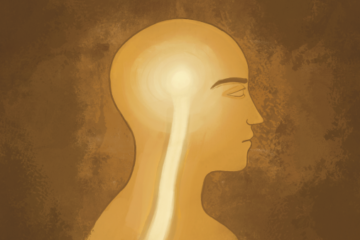
Gently bring your attention to the space between the eyebrows (the bhrumadya). You have to keep your ‘awareness’ and ‘gaze’ at this location. You need to rest your eyes in a relaxed manner and avoid putting too much pressure on them. Understand that it is only a comfortable and happy gaze.
The bhrumadya (or the spiritual eye) is the seat of the mind, and the mind can be controlled right away if you simply concentrate on this location. It is almost a ‘switch.’ It’s a gateway to inner stillness. The self will be reached if you go on gazing at the bhrumadya. By and by, your thought burden will reduce in the mind space, and you will begin to appreciate that you are the pure sky. The bhrumadya dristi triggers introversion (antarmukham), where you come into contact with your internal awareness. Ideally, the practice of gazing bhrumadhya is only complete if you have combined it with throat breathing (pranavidya). The best way to learn this method, however, is under the guidance of a competent master.
How to gaze bhrumadhya?
When you are ‘gazing bhrumadhya’, it is of utmost importance to feel absolutely relaxed. Many do not follow this instruction and do a violent mudra. This can strain the eyes, leading to issues such as headaches, eye strain, and persistent tearing. If you find anything like this happening to you with practice, you should take breaks, close your eyes (when you feel exhausted) and do it as relaxed as possible. To guide you further, meditation is most effective when devotion is infused into practice. This makes the entire practice effortless. The door opens when the pursuit is deeply relaxed. Only do ‘gentle gazing of brumadhya.’
How many hours per day?
Around ‘half an hour’ for beginners is all that it takes. This timing can increase to 1 hour per day in cases of sustained practice. An advanced meditator can consider doing longer hours of meditation. It really depends on the student’s level, and there is no general rule. Ideally, increasing the number of meditation hours should be done in close adherence to your teacher’s instructions, and randomly increasing the duration is not recommended.
Balanced practice is key.
It can’t happen randomly and all of a sudden. Don’t use meditation to escape life! Any addiction is bad. Use meditation to simply remove the conditioned behaviour of the mind. Some organisations recommend long hours of meditation for householders. This can feel fancy, but it could lead to imbalanced living and spiritual hallucinations that are extremely common among students. The students, instead of focusing on daily self-improvement, will hallucinate that they have attained the sublime states. This is seen in many individuals, and I greatly caution you about this. Remember that, as a householder, you have many responsibilities beyond meditation. Sadhana can be a small part of your life. Seva (selfless service) could be another path you could explore. Doing consistent meditation and engaging in pure actions can bring excellent results for you. Sitting for extended periods without preparation can be detrimental to their physical and mental health.
Meditation is a lifelong effort.
Meditation needs proper preparation. Your entire life needs to be spiritually aligned, from the food you eat to the goals you set. Even the company you keep is critical. Having the right company can keep you motivated and support your journey.
Don’t rush to increase meditation time. Use sadhana to get calmness into your life. There is nothing better than balanced living and enjoying the small pleasures of life. You can gradually increase your meditation time over a period of a year or so. Once you receive a go-ahead from your teacher, you can consider increasing it. Unless there is an exceptional student who wants to enter tapas, continuous meditation is not recommended. Meditation is a lifelong effort, and you should plan to make steady progress.
If you wish to learn meditation, you can click the link below to register for our online meditation course.




0 Comments